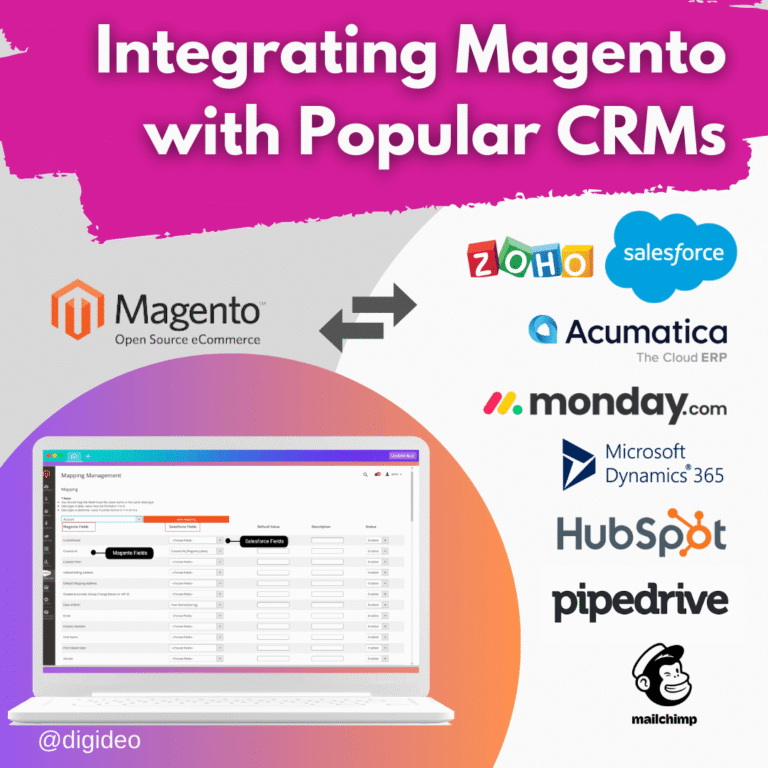
What eCommerce Connectors are worth using for business automation
Connecting online stores, CRM systems, ERP software, marketplaces, and marketing platforms is no longer optional for growing eCommerce businesses. When these systems operate independently, businesses often struggle with duplicated data, manual order processing, inconsistent inventory information, and disconnected customer experiences.
Integration and automation platforms help solve these challenges by connecting applications and allowing information to move between them automatically.
But which integration solution should you choose?
In this article, we compare five popular platforms — Zapier, Zoho Flow, Celigo, BaseLinker, and Make — and explain their features, strengths, and practical applications for eCommerce businesses.

Make.com (formerly Integromat): A No-Code Solution for Custom Workflows
Make.com, previously known as Integromat, is a powerful no-code platform enabling users to build custom workflows without extensive coding knowledge. With a visual, drag-and-drop interface, Make.com allows eCommerce businesses to seamlessly automate and integrate processes across applications.
Key Features:
– Visual Workflow Builder: Make.com’s user-friendly interface enables businesses to map out complex workflows and connect multiple systems easily.
– API Integrations: Offers extensive API integrations, allowing users to connect Make.com with virtually any app, from CRMs and ERPs to eCommerce platforms.
– Scenario Execution: This feature allows users to set conditions and define triggers for specific scenarios, enabling tailored automation that suits a business’s unique needs.
Best Use Cases:
Make.com is particularly valuable for businesses creating customized workflows, such as automating email notifications for abandoned carts, syncing customer data between the eCommerce platform and CRM, or managing inventory levels. It’s excellent for eCommerce teams who want to tailor their workflows without hiring developers.
Baselinker
BaseLinker is an EU eCommerce operations platform designed to help merchants manage multiple online stores, marketplaces, products, orders, and shipping processes from one system.
Unlike general-purpose automation platforms, BaseLinker focuses specifically on the operational challenges of multichannel retail.
It connects online stores and sales channels such as Allegro, Amazon, and eBay with shipping providers, inventory systems, and accounting or ERP applications.
For companies selling through several marketplaces, BaseLinker can become a central platform for managing orders and product availability.
The benefits of this integration for merchants are:
- the possibility of comprehensive service of all orders flowing to the online store,
- simple and effective integration with various e-commerce tools,
- the possibility of mass publication of both offers in the store and auctions on online platforms
- The warehouse operation is simple thanks to the automatic synchronization of stock levels.
Key Features:
- Order Management: BaseLinker consolidates orders from multiple marketplaces, such as eBay, Amazon, and Allegro, into one interface, simplifying order tracking and fulfillment.
- Inventory Synchronization: Automatically updates inventory across all connected sales channels, preventing overselling and stock discrepancies.
- Shipping Integrations: BaseLinker integrates with major shipping carriers and automates shipping label generation, order status updates, and delivery tracking.
The biggest strengths of Baselinker’s integration solution are:
- one e-panel for your shop management
- even if you don’t need your shop platform to post products to the marketplaces.
Best Use Cases:
1. Multichannel sales management
Manage orders from Shopify, WooCommerce, Allegro, Amazon, eBay, and other supported channels in one interface.
2. Inventory synchronization
Keep product availability consistent across connected marketplaces and stores, reducing the risk of overselling.
3. Shipping automation
Automatically create shipment labels, assign shipping methods, and update tracking information.
4. Marketplace listing management
Publish and update product offers across different sales channels without editing each listing independently.
5. ERP and accounting connectivity
Exchange relevant sales, inventory, and document information with supported back-office systems.
Best suited for:
Online retailers, wholesalers, and distributors selling across multiple marketplaces and requiring centralized order, inventory, and shipping operations.
Zapier: A Popular Tool for Quick, Easy Integrations
Zapier is one of the most widely recognized no-code automation platforms. It allows businesses to connect applications and automate repetitive tasks without building custom integrations.
Zapier is particularly useful for small and medium-sized online businesses that want to automate everyday operations quickly.
Its automation workflows, called Zaps, use triggers and actions. For example, when a new order is placed in Shopify, Zapier can automatically create a record in a CRM, notify the sales team, or update a spreadsheet.
Key Features
- Extensive library of application integrations, including eCommerce, CRM, marketing, productivity, and customer support tools.
- No-code automation builder with preconfigured templates.
- Multi-step workflows with filters, conditional paths, and data formatting.
- Webhook and API capabilities for connecting additional services.
- AI-assisted automation features and data management tools.
- Task history and monitoring to help troubleshoot workflows.
Best Use Cases for eCommerce Businesses
1. Customer data synchronization
Automatically transfer customer information from Shopify or WooCommerce to a CRM such as HubSpot or Zoho CRM.
2. Marketing automation
Connect store events with marketing platforms such as Mailchimp or Klaviyo to trigger follow-up campaigns, customer segmentation, or review requests.
3. Order notifications
Notify sales or fulfillment teams through Slack, Microsoft Teams, or email when important orders are placed.
4. Lead management
Transfer new inquiries from forms, landing pages, and advertising lead forms into the CRM and assign follow-up tasks.
Best suited for:
Small and medium-sized eCommerce businesses looking for straightforward integrations and quick automation without extensive technical development.

Celigo: Enterprise-Level Integrations for eCommerce and Beyond
Celigo is an integration platform as a service (iPaaS) designed to connect business systems and automate processes across multiple applications.
Compared with lightweight workflow automation tools, Celigo is particularly focused on structured integrations involving eCommerce platforms, ERP systems, marketplaces, fulfillment services, and financial applications.
It is well suited to businesses managing complex data synchronization and high-volume transactions.
For example, a company using Shopify and NetSuite can use Celigo to synchronize orders, customers, inventory, fulfillment updates, and financial information.
Key Features:
– Pre-Built Integration Apps: Celigo offers pre-built integrations for platforms like Shopify, BigCommerce, NetSuite, Magento and Salesforce, along with customizable options.
– Scalability: Built for businesses with large-scale operations, Celigo supports high data volumes and complex workflows.
– Monitoring and Analytics: Celigo includes robust monitoring tools that give users insight into workflow performance and data flows.
Best Use Cases:
- eCommerce-to-ERP integration
Connect Shopify, Adobe Commerce, or other supported platforms with ERP solutions such as NetSuite or Microsoft Dynamics 365.
- Multichannel order synchronization
Bring marketplace and online store orders into centralized business systems for processing.
- Inventory and fulfillment management
Synchronize inventory availability, shipments, and order status across different systems.
Connect B2B storefronts with ERP data, including customer accounts, company information, negotiated pricing, catalogs, and fulfillment processes.
- Financial process automation
Reduce manual accounting work by synchronizing transactions, refunds, and related financial information between systems.
Best suited for:
Medium-sized and larger eCommerce businesses with complex ERP integrations, multiple sales channels, and business-critical synchronization requirements.

Zoho Flow – Connecting eCommerce With CRM and Business Operations
Zoho Flow is a low-code integration and automation platform developed by Zoho. It connects applications and automates data exchange between them.
It is particularly attractive to businesses using Zoho CRM, Zoho Inventory, Zoho Books, Zoho Analytics, or other applications within the Zoho ecosystem.
Zoho Flow also connects with third-party platforms, allowing businesses to integrate eCommerce operations with accounting, customer service, and marketing systems.
Key Features
- Visual workflow builder for connecting business applications.
- Native integration capabilities across the Zoho ecosystem.
- Connections with third-party applications, including Shopify, WooCommerce, and popular business tools.
- Conditional logic, decision branches, delays, and multi-step automation.
- Custom functions using Deluge scripting for more advanced business logic.
- Webhooks and API-based connections.
- Workflow execution history and troubleshooting capabilities.
- Integration with Zoho CRM, Books, Inventory, Analytics, and other business applications.
Best Use Cases for eCommerce Businesses
1. eCommerce and CRM integration
Connect Shopify, WooCommerce, or another supported store to Zoho CRM, allowing teams to manage customer information, sales activity, and post-purchase processes.
2. Order and financial workflows
Transfer order information to Zoho Books or other accounting systems, subject to the supported integration and required data mappings.
3. Inventory-related automation
Connect eCommerce events with Zoho Inventory to support order processing, fulfillment workflows, and inventory updates.
4. Customer lifecycle automation
Use customer and purchase events to trigger actions in Zoho CRM and marketing applications, such as customer segmentation, account follow-up, and post-purchase communication.
5. Reporting and analytics
Move relevant operational information between connected applications to support reporting in Zoho Analytics.
Best suited for:
Businesses already using Zoho applications or planning to implement Zoho CRM, finance, and operational tools alongside their eCommerce platform.
Which eCommerce Connector Should You Choose?
Platform | Primary Strength | Best Business Fit |
|---|---|---|
Zapier | Simple no-code automation | Small businesses, marketing and CRM workflows |
Zoho Flow | Zoho ecosystem integration | Businesses using Zoho CRM, Books, Inventory, and related apps |
Celigo | Advanced ERP and business process integration | Growing mid-market and enterprise eCommerce |
BaseLinker | Marketplace, order, and inventory operations | operations Multichannel retailers and marketplace sellers |
Make | Flexible, customizable workflow automation | SMEs and technical teams managing complex workflows |
There is no universally best eCommerce connector. The right solution depends on existing technology, integration requirements, transaction volumes, and available technical resources.
For example:
- A small Shopify store may prefer Zapier for marketing and customer service workflows.
- A company using Zoho CRM and Zoho Books may find Zoho Flow a natural starting point.
- A fast-growing retailer using NetSuite may benefit from Celigo’s structured ERP integrations.
- A business selling through Allegro, Amazon, and its own store may prioritize BaseLinker for multichannel operations.
- A company with specialized workflows and API requirements may choose Make for greater flexibility.
In some cases, using more than one platform is reasonable.
For example, BaseLinker might manage marketplace orders and inventory, while Zoho Flow or Make handles CRM updates and marketing automation.
The important principle is to avoid duplicating integration responsibilities or creating conflicting data synchronization processes.
What Should eCommerce Businesses Consider Before Choosing an Integration Platform?
Before selecting a connector, businesses should evaluate several factors.
A prebuilt connector is not automatically the best choice. In some cases, a native application integration or a carefully designed custom API connection may provide better reliability and lower long-term costs.
Conclusion: Build an Integration Strategy, Not Just Individual Automations
eCommerce automation delivers the greatest value when integrations support an overall business process rather than a collection of disconnected tasks.
The goal is not simply to connect applications. It is to create a reliable flow of information between online stores, marketplaces, CRM systems, financial software, and operational tools.
Zapier, Zoho Flow, Celigo, BaseLinker, and Make can all play valuable roles in this architecture.
The right selection depends on business requirements, existing applications, integration complexity, and future growth plans.
Not Sure Which Solution You Need?
You may not need a new platform or a large implementation.
Sometimes the best first step is an audit, a process review or an independent roadmap.
During an initial consultation, we can discuss:
- Your current business challenges
- Existing platforms and applications
- Manual processes and integration gaps
- Sales and marketing priorities
- Reporting requirements
- Possible project scope
- Recommended next steps